
Exploring the Roots of Gurjara Desa
Dive into the Roots of Gurjara through the epic Vasantavilasa by Balachandra Suri and discover how Gurjaradesha shaped the heritage of North Gujarat & Southern Rajasthan.
Akriti Panchal
10/10/20253 min read
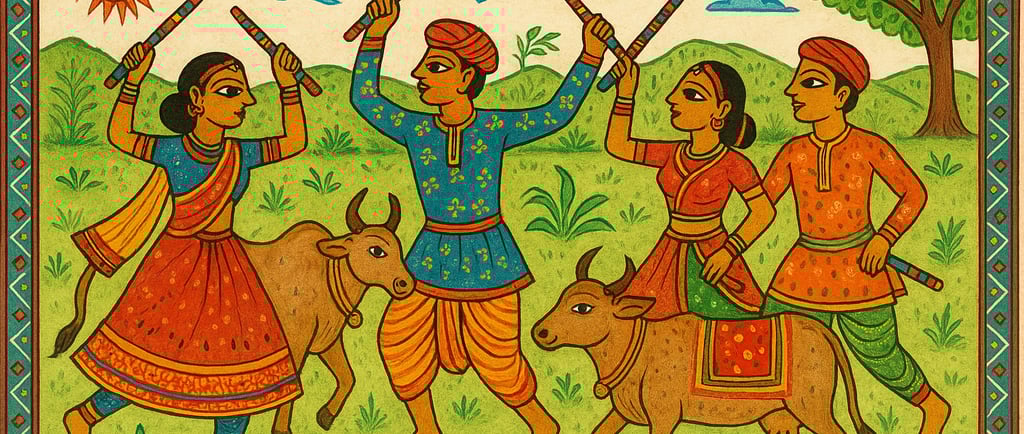
The phrase “Roots of Gurjara” refers not merely to a people or a tribe, but to the ancient cultural and geographic realm of Gurjaradesha — the historic land spanning parts of southern Rajasthan and northern Gujarat.
By exploring these roots we connect past dynasties, sacred literature, temple architecture and modern identity in western India.
A central text in this journey is the Vasantavilasa, a poetic work by Balachandra Suri, which evokes the essence of Gurjaradesha in the 13th century CE. (Wisdom Library)
In short, the “roots” here refer to a civilisation, a land of heritage — rather than a race or tribe.
The Land Called Gurjara: Nature & Nomenclature
The territory of Gurjaradesha, or “Gurjara country,” stretched between the Aravalli Hills and the riverine plains of Gujarat.
In Vasantavilasa (Part I: “Origin of Gurjaradesa and its people”), Balachandra Suri treats Gurjara as a region and community of its land — a cultural collective, not an ethnic label. (Wisdom Library)
Thus one of the first steps in our exploration is to assert that “Gurjara” refers to the inhabitants of that land, not a separate race.
This identifies the “roots” of Gurjara as territorial, institutional and cultural.
Literary Witness: Vasantavilasa & the Cultural Memory
The epic Vasantavilasa by Balachandra Suri (13th century) serves as a key source for understanding Gurjaradesha.
It was composed in praise of the minister Vastupala of the Chaulukya dynasty, but crucially includes a section titled “Origin of Gurjaradesa and its people”. (Wisdom Library)
This clarifies several important points for our blog:
The region of Gurjaradesha had long been established by the 13th century as a cultural zone.
Poets and scholars saw value in tracing the collective identity of its people and land.
The epic links literary, political and architectural achievements in Gujarat with the deeper foundations of Gurjara society.
Therefore, for your website, invoking Vasantavilasa lets us emphasise continuity: from ancient land to medieval culture to modern heritage.
Political & Architectural Legacy of Gurjara Roots
One of the strongest manifestations of Gurjara roots lies in the political and architectural achievements of the region.
Key elements include:
The rise of the Chaulukya (Solanki) dynasty in Gujarat and their patronage of temple architecture.
The emergence of the Maru-Gurjara style, which blended local traditions of Gurjaradesha with pan-Indian temple forms.
Vasantavilasa’s detailed account of cantos describing the cities of Anahilapataka and the ministers Vastupala & Tejapala who built temples, step-wells and literary institutions. (Wisdom Library)
Thus the “roots of Gurjara” show up not only in geographic terms but in built heritage and institutional memory.
Culture, Society & Continuity from Past to Present
The roots of Gurjara are also cultural — in language, faith, art and community life.
Language & Learning: The text of Vasantavilasa praises Goddess Sarasvati and positions poets as preservers of history. (Wisdom Library)
Religion & Society: Jain, Shaiva and Vaishnava traditions flourish in the region, suggesting pluralism in Gurjaradesha.
Art & Heritage: Folk dances, temple festivals and temple architecture in north Gujarat and southern Rajasthan today reflect the long-term cultural roots of Gurjara.
By tracing these threads we highlight that the “roots” are alive — not merely relics but foundations of regional identity.
Modern Relevance: Roots Giving Rise to Identity
Why does the concept of roots of Gurjara matter today?
It reframes Gujarat and southern Rajasthan as parts of a unified cultural sphere rooted in Gurjaradesha.
It enables heritage tourism, scholarship and cultural awareness to find deeper meaning in sites, manuscripts and traditions.
It provides continuity: the region’s past is not severed but still alive in practices, heritage architecture and collective memory.
By positioning your website as a platform exploring these “roots”, you allow visitors to understand western India’s history not as isolated episodes, but as a continuous legacy.
Conclusion: Rooted in the Land, Flourishing in Culture
The “Roots of Gurjara” are as much about land as they are about people — inhabitants of Gurjaradesha who built temples, composed poetry, engaged in trade, and forged a sophisticated civilisation in western India.
By recognising that “Gurjara” refers to those who belonged to the land of Gurjaradesha, not to a separate race or tribe, we reclaim a more accurate heritage. This rooted identity forms the basis for the cultural and historical continuity of north Gujarat and southern Rajasthan.
Let this understanding guide your readers — from ancient texts like Vasantavilasa, through the rising temples of the Chaulukyas, to the rich traditions that persist today. Their journey into the roots of Gurjara is also a journey into the living soul of western India.